Why WordPress Stopped Working for Serious Businesses

Alexander Capio
Your infrastructure determines your growth ceiling. Businesses that scale fastest aren't using more tools, they're using the right system. Let's build yours.
Serving businesses across the United States, Latin America, and Spain.
I was barely old enough to drink legally when I became a part-owner of a marketing agency. The original partners had split, and overnight I inherited a seasoned media buyer, a full sales team, a website designer, and a remote development team. No business school. No playbook. Just the work and the stubborn belief that figuring it out fast could become an advantage.
What happened next shaped everything. The clients we were suddenly responsible for were not small. We were working with large US corporations, companies with real marketing budgets, real expectations, and zero patience for excuses. Sitting across the table from those clients at an age when most people are still in college taught me something that has never left me: digital marketing was a young person's game. The executives in those rooms understood the budget. The young people in the room understood what was actually happening online. The ones who could do both were the ones who closed the deal.
Is your website still supporting growth,
or quietly holding it back?
Why WordPress holds businesses back and what a custom website delivers instead. Watch on YouTube.
In a 3-and-a-half-minute summary, this video shows why WordPress may be holding back your business and how unified infrastructure (built-in SEO, integrated CRM, AI automation) changes the results.
In the early 2000s everything we built, we built by hand. Design lived in Photoshop. Code lived in HTML, early CSS, and server-side scripts. Landing pages were not yet a concept. If a client wanted a website that ranked and loaded reliably, there was exactly one way to do it: write clean code, structure it intentionally, keep it lean. SEO worked because pages were server-rendered by default and there were no shortcuts.
Those sites were not cheap. A properly built, SEO-ready website in the early 2000s commonly ran between $8,000 and $20,000, and significantly more for multilingual or dynamic content. Clients accepted this because expertise was genuinely scarce and execution genuinely mattered. I learned during that period that the businesses that moved fast when a technology was still maturing were the ones that built durable advantages. The ones that waited for the playbook to be written were playing catch-up permanently.
Want advanced digital infrastructure for less than 20% of what it cost twenty years ago? Get in touch and we’ll show you how.
Message usAround 2010, after selling my agency and moving into consulting, I discovered WordPress. I was genuinely excited. For the first time clients could have a real CMS, a blog strategy, and functional SEO without needing a developer for every small change. Plugins handled meta titles, sitemaps, and contact forms. Templates looked professional out of the box. The barrier to entry collapsed.
For several years WordPress was absolutely the right tool. It democratised web publishing in ways that would have seemed impossible a decade earlier. Today it powers roughly 43% of all websites on the internet. That is a remarkable achievement. But I had seen this pattern before. Every technology that lowers the barrier to entry eventually becomes the floor, not the ceiling. And when everyone is using the same platform, the platform stops being a competitive advantage and starts being a shared constraint.
"Every technology that lowers the barrier to entry eventually becomes the floor, not the ceiling."
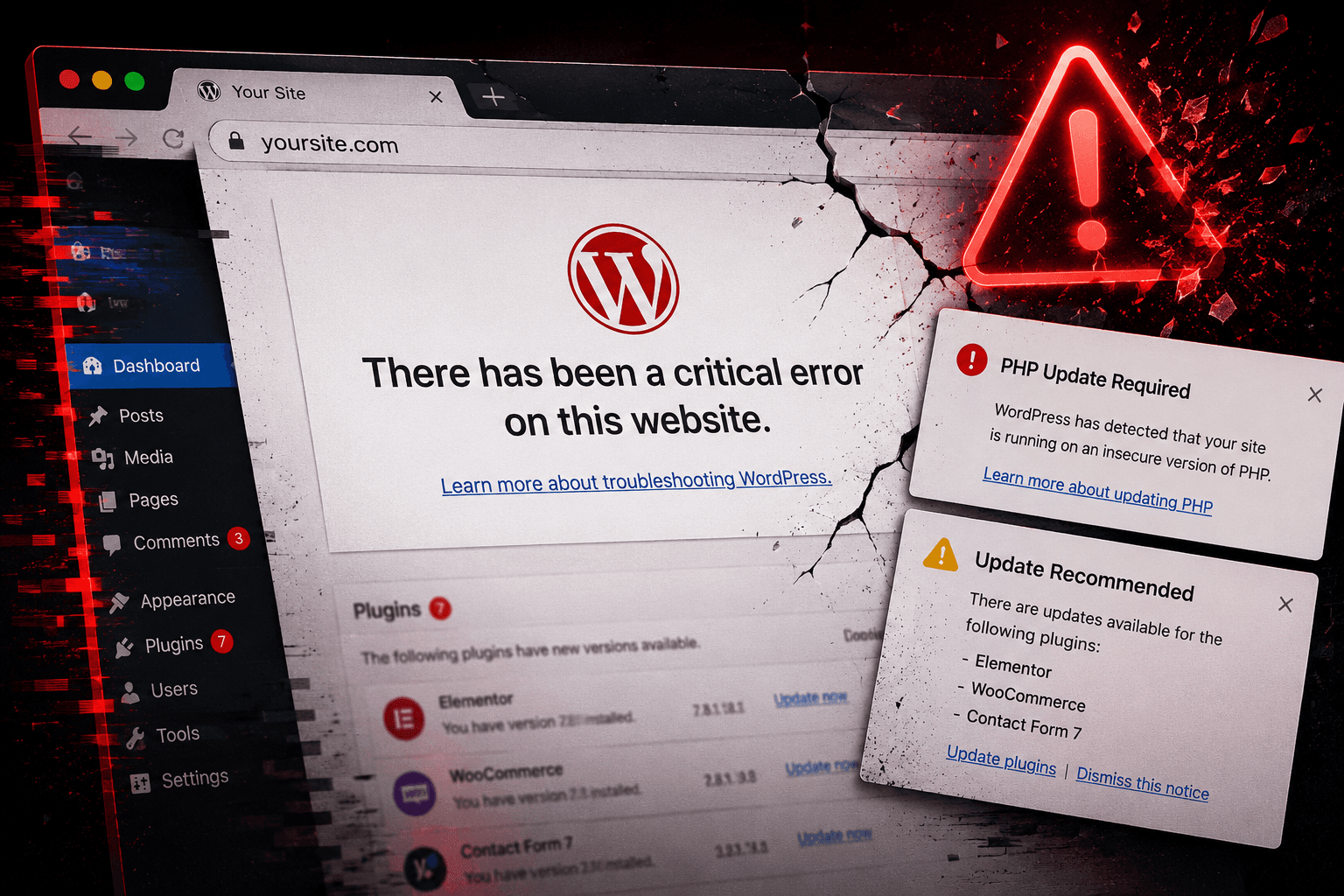
Alexander Capio, CEO, CavidasWordPress does not fail suddenly. It fails gradually, then all at once. The moment a business starts taking SEO, automation, and conversion seriously, the structural problems surface. These are not fixable with another plugin. They are architectural.
WordPress did not become bad. It was never designed to be the operational core of a modern business. It was built to publish content. When businesses ask it to do far more than that, it reaches its structural limit. I had watched the same thing happen in the early 2000s with hand-coded static sites. The technology had not failed. It had simply been outgrown.
Recognise any of these symptoms on your own site? Send us a quick WhatsApp and we'll tell you if it's fixable or needs a rebuild.
Message usWatching large US corporations navigate the early internet from the inside taught me that every major technology wave follows the same pattern. First, the people who understand the new technology move fast and build advantages. Then, platforms emerge that lower the barrier to entry and commoditise what was once expertise. Then a new wave arrives and separates the people who genuinely understand the fundamentals from the people who were only using the tools.
AI is that next wave. I had seen it coming clearly enough to know that this moment called for the same combination that worked in the early 2000s: seasoned strategic experience paired with young partners who are genuinely ahead of the technology, not just users of it.
The early internet was a young person's game. Then it got democratised. Then it got commoditised. AI is resetting the clock. The businesses that move now, with the right infrastructure, will own the next decade the way the fast movers of 2003 owned the last one.
I had spent twenty years learning how large corporations actually make technology decisions, what separates marketing that converts from marketing that reports, and why most agencies deliver activity instead of results. What I needed was a team that was living inside the newest layer of the technology stack every single day. That required partners of a different generation.

Artificial intelligence is opening a new chapter for businesses in Spain.
I had been living in Spain for over three years when I finally returned to the United States. I came back with a clear picture of something I had been observing for a long time: the Spanish business market was digitally underserved in a very specific way. Ambitious, well-run companies were operating with fragmented tools, agencies selling them commodity WordPress builds, and no real system connecting their web presence to their sales pipeline. The American playbook did not transfer cleanly to Spain. The framing was wrong even when the tactics were right.
Then I met Daniel López, by pure chance, in the Orlando area. Dani is from Málaga. He had spent years in sales in the US, building the kind of instincts that only come from closing deals in a market that is not your own. We realised quickly that we had been circling the same problem from opposite directions. He understood Spanish business culture from the inside: the relationships, the pace, and the way decisions actually get made. I understood the infrastructure gap. And he could name something I had felt but struggled to articulate: the cultural disconnect that cost deals even when the strategy was right.
He mentioned Málaga. I knew it well. I had worked with a resort there and had always felt the city had something unusual: genuine international energy built on deep local roots. When Dani said he wanted to build something there, the conversation moved fast.
Since then, Daniel has become COO of CAVIDAs and has specialised in cannabis marketing, SEO, local business marketing, sales, and lead generation. His work focuses on connecting strategy, customer acquisition, and commercial processes to help businesses increase visibility, generate qualified opportunities, and turn them into sustainable growth.
Want to speak directly with Daniel about SEO, lead generation, or commercial growth?
Book a call directly through his calendar.
Dani had a network that surprised me. Not because of its size, but because of its quality. Years of school friendships, university connections, and professional relationships had quietly built into something remarkable. People who had gone on to work inside Banco Sabadell, Salesforce, Google, and Meta. Young, technically excellent, and motivated by something genuine, a desire to build something that actually moved the needle for Spanish businesses rather than accumulate experience inside a multinational.
His closest friend from school was Víctor Gómez, a developer and designer who was not just technically strong but genuinely ahead of the curve on where web development and AI integration were going. Víctor became our third. Then a fourth joined. Then more. People heard what we were building and wanted to be part of it. Within months Cavidas existed, not as a slide deck, but as a team of people who had already spent years inside the platforms, pipelines, and algorithms that the next generation of business infrastructure required.
That combination of strategic experience from twenty years inside major US corporate marketing operations, paired with young Spanish partners who are not just using the latest technology but building with it, is exactly what this moment in digital requires. Not one or the other. Both.
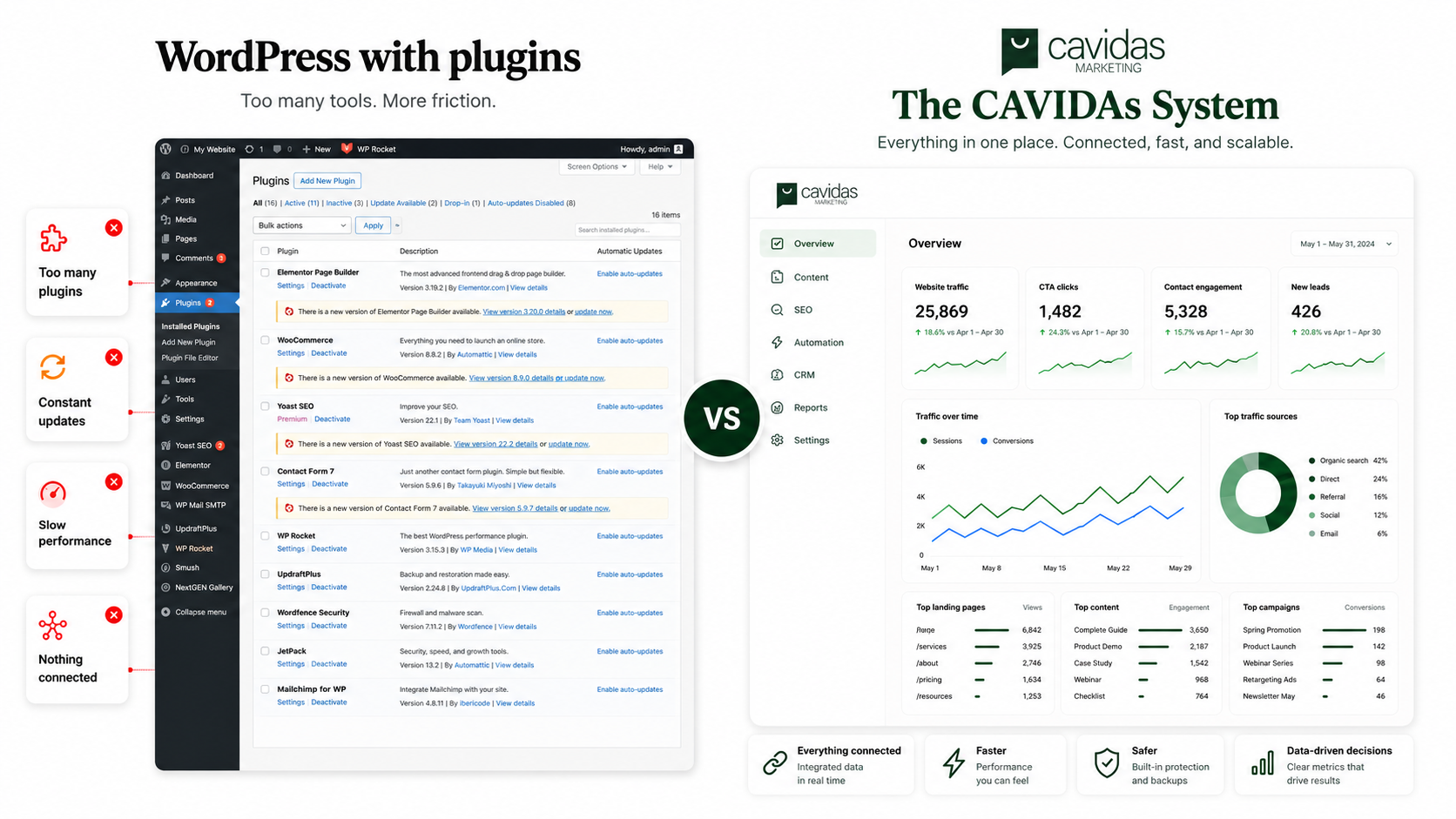
Disconnected plugins versus one unified digital infrastructure.
The premise was straightforward: stop selling disconnected tools and deliver unified infrastructure. A custom-coded web platform fast by default rather than fast by patch, combined with an integrated CRM, conversion funnels, SEO built into the architecture from line one, AI-powered automation, and performance advertising managed from a single system.
No plugin dependencies. No fragile third-party integrations. No performance ceiling reached after eighteen months of growth. The sites that perform best today share the same fundamentals as the sites we built in the early 2000s: server-rendered HTML, clean output, controlled structure, and performance that was never an afterthought. The difference is that we can now pair those fundamentals with a genuinely usable CMS, an AI-powered CRM that qualifies and follows up with leads automatically, and a full paid advertising operation where every campaign feeds back into the same system.
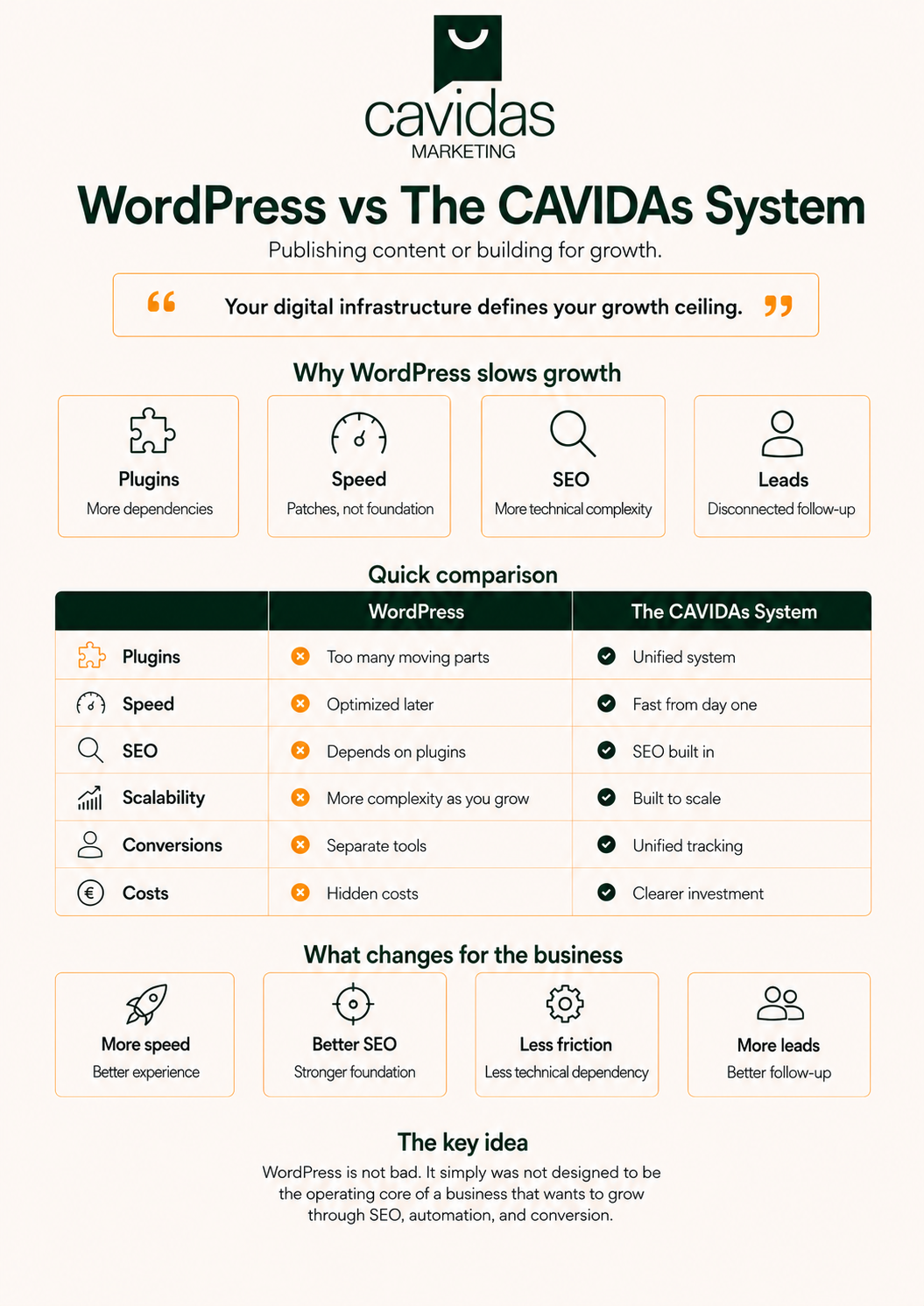
A WordPress alternative built for performance, conversion, and growth.
What replacing WordPress actually delivers
These are not outliers. They are what happens when a business stops bolting marketing tools onto a fragile foundation and starts operating from a system built to convert from day one, with AI automation handling the follow-up that most businesses are losing leads on right now.
How custom-built infrastructure solves what WordPress cannot.
Curious what a system like this would look like
running inside your business?
Cavidas works best for businesses that have outgrown their current setup, whether that is WordPress, Squarespace, a disconnected CRM, or an agency relationship that delivers reports instead of results. We work with SaaS companies, ecommerce brands, service businesses, and B2B companies across Spain and beyond.
What they share is not size or sector. It is the recognition that their current infrastructure is a ceiling, not a foundation, and that the AI wave is not something to observe from the sidelines. The tools have changed. The algorithms have evolved. The fundamentals that drive growth, clean architecture, connected data, automated follow-up, and a team that understands both the strategy and the technology, have never changed.
Not sure if your case fits? Send us a message and we'll tell you straight, no runaround.
Ask usCommon questions
The best WordPress alternative for businesses that need speed, integrated SEO, CRM, and marketing automation in one place is a custom-coded platform. Unlike WordPress, a purpose-built system requires no plugins, delivers native technical SEO, and connects your entire marketing and sales stack without third-party integrations that conflict and break under load.
Growing businesses replace WordPress when plugin conflicts, poor Core Web Vitals scores, disconnected CRM systems, and the inability to scale multilingual or multi-location SEO make the platform a source of technical debt rather than a growth tool. WordPress was built to publish content. Modern businesses need it to generate leads, qualify them automatically, and close sales.
Not when you calculate the real cost of WordPress over three years: hosting, premium plugins, developer maintenance contracts, security patches, performance optimisation, and the full rebuild most businesses face eventually. Custom platforms built properly are often comparable in total cost and dramatically outperform WordPress on SEO ranking, conversion rate, and reliability.
Cavidas was built from Málaga specifically for the Spanish market. We understand the cultural nuances of Spanish business, build hreflang-correct multilingual sites natively, and have documented results with clients across Madrid, Málaga, and beyond, including a 68% reduction in cost per lead and 11x ROI within 90 days for Spanish companies that made the switch.
In 30 minutes we will tell you exactly which one and map the fastest path to fixing it.
Book Your Free Strategy CallNo commitment. No sales pressure. A clear plan you can act on immediately.