SEO vs GEO in Spain: Get Found by ChatGPT & AI Search
I ran CPC campaigns on Overture before Google Ads existed. I wasn't old enough to get a loan, but banks paid me to manage their bids so they'd show up on AOL and Yahoo. That's over 20 years in this business now, and I've watched search reinvent itself every five or six years like clockwork. Keyword stuffing worked, then it didn't. Backlinks became currency, then Google went after everyone treating the internet like one giant link exchange. Content became king, which mostly meant 2,000 words of nothing because somebody's SEO plugin turned green.
Now it's happening again, except this time the search engine has an opinion. ChatGPT, Gemini, Perplexity, Google's AI Overviews, they don't hand someone ten blue links and let them pick. They compare the options and tell people what to consider.
Marketing responded the way marketing always responds to something new: by inventing a pile of acronyms. GEO, AEO, LLMO, AI SEO, probably two more since I started writing this sentence. Any who, the name matters less than what's actually happening.
Traditional SEO gets a page to show up in results. GEO, Generative Engine Optimization if you want the full term, is about a business being clear and credible enough that an AI model actually cites it, mentions it, or recommends it inside a generated answer. Those are three different things, and I'll get to why that distinction matters in a minute.
We didn't set out to become a GEO agency, for the record. Clients started telling us they'd been found through ChatGPT, and we had to work backwards to figure out why. But before I get into that, I need to tell you where I got it wrong first, because that's the part that actually taught me something.
Already suspect your site has technical or citation problems? Skip ahead and book a Search and AI Visibility Review.
Book a ReviewThe Formula Never Really Changed, Just the Weight
SEO has changed constantly over 20 years, but the underlying formula hasn't changed nearly as much as the panic around every Google update suggests. What changed is which piece gets the most weight at any given time.
Early on, clean code and a fast page could carry you a long way because there wasn't much competing for attention. Then structure mattered more, titles, headings, internal links, descriptions that made someone want to click instead of reading like they were written during a hostage negotiation. Then Google got better at judging whether a page actually helped the person reading it, which is a nicer way of saying Core Web Vitals started punishing sites that were slow and useless.
Underneath all of it, three layers never stopped mattering, they just traded the spotlight back and forth. What you say on the page. Whether machines can actually read and understand it. And who else, outside your own website, backs up what you're claiming. That third one, off page, spent years as the boring workhorse nobody wanted to talk about at conferences. Now that AI models are comparing sources before they answer, it might be the most interesting part of the whole thing.
Ranking, Cited, Mentioned, Recommended: Four Different Outcomes in AI Search
GEO isn't a replacement for SEO. It's what happens when good SEO, clean business information, and authority spread across the wider internet get run through a system that generates an answer instead of showing a list.
Here's what most of the shiny "AI visibility" reports conveniently skip. A page can rank fine in Google and never get pulled into an AI answer at all. An AI answer can mention your company while citing a review site, a Reddit thread, or a competitor's comparison page instead of your own site. And a brand can appear somewhere inside an answer without being one of the businesses the model is actually recommending. A screenshot of your name inside ChatGPT feels good. It's not proof you won anything.
| Outcome | What happened | What it proves | Commercial value |
|---|---|---|---|
| Ranking | Your page appears in traditional search. | Google considers the page relevant. | Visibility and potential clicks |
| Citation | An AI answer links to your page as a source. | Your content supported part of the answer. | Authority and referral traffic |
| Mention | The answer names your brand, possibly citing another source. | The brand is associated with the topic. | Awareness and consideration |
| Recommendation | The AI actively suggests your business for the user's need. | Multiple signals support relevance and trust. | Highest potential buying intent |
Google's own guidance says there's no secret schema or hidden technical trick for showing up in AI Overviews or AI Mode. Their existing SEO advice still applies, just with more weight on genuinely useful content, technical clarity, accurate local info, and images and video that actually add something.
Where I Got It Wrong First
Late 2022, ChatGPT drops and takes over every conversation in marketing. Claude wasn't even mainstream yet. I was in Spain at the time, stepping back from my US life, and I picked up a client, a dentist in Madrid building a B2B business coaching other dentists on growing their practices. He'd already bought Clientify, this clunky old marketing platform, before we started.
My reputation back in the US had always come from how fast I could get a site to rank, no black hat, no shortcuts, just structured SEO done correctly, learned the hard way over years instead of guessing at whatever Google would reward next. So I had a decent formula going in. Then I discovered what ChatGPT could do with text and honestly couldn't believe it. I've always been able to spit opinions out on paper pretty naturally, so pairing that with AI editing felt like a superpower. I'd write in my so so Spanish, run it through AI to clean up, publish. It started ranking. Fast.
I thought, that's it, I never have to actually write again, just let AI spit it out and structure the technical side the way I always have.
Then the Wheels Came Off
More clients came in through referrals from that dentist. I leaned harder into the shortcut, AI draft, light edit, publish, next client, repeat. That's when I saw the cracks. Inaccuracies. Phrasing generic enough to describe any dental practice in any city. Confident claims that weren't quite right. Pages that technically had the keyword and no real reason to exist.
I got better at prompting eventually. But the real fix was learning to use AI as an editor and a research assistant, never as the source of the actual expertise. Google's guidance draws the same line, generative AI can help with structure and research, but pumping out pages without adding anything can trip their scaled content policies. The problem was never using AI. The problem was letting it replace the part that was actually interesting.
My Reddit Era, Yes Really
I was never a Reddit person. Like my grandfather trying to operate a DVD player, I was completely lost the first time I opened it. I'd made the same mistake with Instagram once, writing it off as a place for pre-teen girls posting ducklip selfies right before it became one of the most precise ad platforms marketing has ever had. Wasn't making that call twice.
So I dove in properly. Became an actual Redditor, not someone dropping a link and running. I probably have multiple personalities in real life too, but I definitely developed a few on Reddit. Luxury European fashion, anti aging treatments, dental business courses, luxury hotels, cannabis club culture through Spain420. People started upvoting me across all of it.
What mattered wasn't the links. Most of the time there weren't any. What mattered was watching how people actually ask questions when they're not typing keywords into a search box. They explain their situation, throw in oddly specific requirements, reject the obvious answer, ask a follow up. Which is exactly how people talk to AI search.
Semrush analysed 248,000 Reddit URLs surfaced across ChatGPT Search, Perplexity, and Google AI Mode. Q&A, comparison, and discussion threads dominated the citations, and many cited posts had fewer than 20 upvotes and comments. The useful lesson is not that virality wins. Clear, direct, specific answers can surface without enormous engagement.
That doesn't mean go make a fake account and post "has anyone else noticed Brand X is amazing." Reddit users can smell a promotional post from three postcodes away. It means paying attention to what people are actually asking in your space and showing up with a real answer when you have one.
Then LinkedIn Started Showing Up Too
Around the same time SEO started shifting under my feet. Instagram profiles ranking for branded searches. Reddit threads landing on page one for questions that used to belong to blog content. LinkedIn articles becoming a real source. Then Google's AI Overviews arrived and traffic on several client accounts moved in ways that didn't match any algorithm update I recognized.
I've heard "this update changes everything" too many times to count, so I didn't panic. I went and looked.
Semrush also analysed 89,000 LinkedIn URLs cited across AI search. Long-form LinkedIn articles accounted for roughly 50–66% of the LinkedIn content cited across the models studied, while ordinary feed posts represented approximately 15–28%. That does not make every LinkedIn article authoritative, but it does show why structured, indexable expertise performs a different job from a passing feed update.
A proper LinkedIn article works differently than a feed post. It's longer, structured, and easier for a model to retrieve. The short post still matters, it's how the idea gets in front of people and starts a conversation, it just does a different job than the article does.
Publishing Everywhere Doesn't Mean Copying Everywhere
We distribute expertise across the platforms that actually matter for a given client, LinkedIn, Reddit, YouTube, Google Business Profile, Instagram, TikTok, Pinterest, X, industry publications, relevant communities. That doesn't mean pasting the same AI caption onto nine platforms and calling it omnichannel. A LinkedIn article should read like professional insight. A Reddit answer should solve the problem without turning into an advert. A video has to work for someone who never reads the original blog post. Each platform does its own job, but all of them need to reinforce the same business, the same expertise, the same facts.
Then Our Clients Started Telling Us How They Found Them
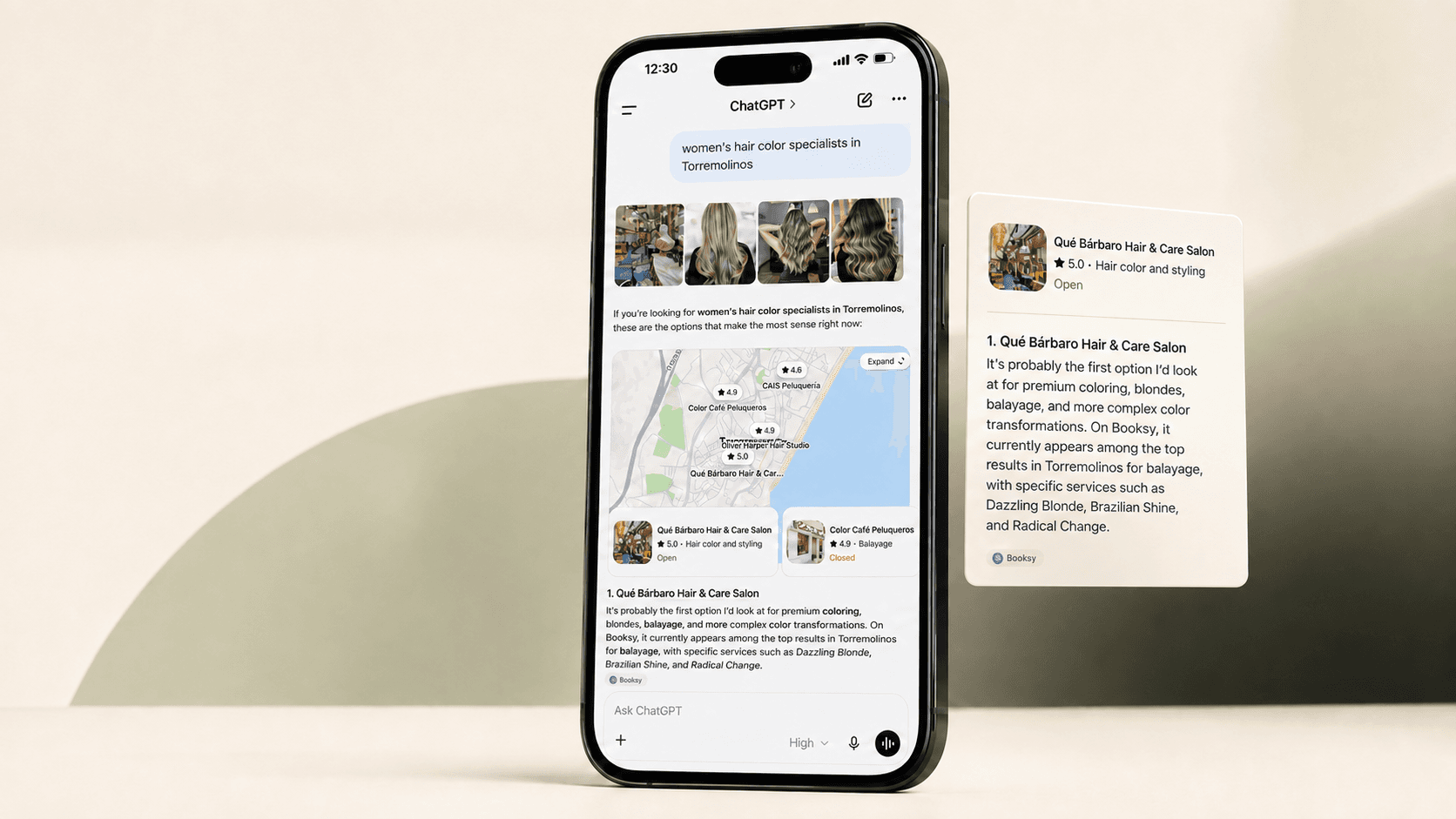
This is where it stopped being theory. A customer told Qué Bárbaro they'd found the salon through ChatGPT. A lead told Málaga Forum's team they'd asked Google's AI search to find event options in Málaga and gotten a direct answer, no results page involved. Across Qué Bárbaro, Málaga Forum, Falcanna, and a private clinic we work with in Madrid, businesses we'd built were getting surfaced by name.
We hadn't run a separate GEO campaign for any of them. So we went back through the work and reverse engineered what was actually getting picked up.
Qué Bárbaro had structured service and location content, a real Google Business Profile, and consistent listings across the mapping and directory ecosystems that matter, with genuine multilingual information rather than a machine translated afterthought.
Málaga Forum's search behavior is more complicated than "event venue Málaga." Someone booking a 400 person corporate event is asking about capacity, parking, production access, catering flexibility, nearby hotels. The more specific the question, the more it matters whether those answers exist in clear content, event listings, media, and third party references, not buried in a PDF nobody indexed.
Falcanna operates in a sector where advertising is restricted and vague language creates both a compliance problem and a discovery problem. Clear bilingual content, consistent local information, and FAQs that actually answer what people are asking helped both users and machines understand what the business is and where it operates.
The clinic is the one that made me the most careful, because healthcare can't be treated like a volume game. It's a private practice in Madrid, and the questions people ask an AI model about a clinic aren't casual. Who's actually qualified. Whether the claims on the page are accurate. Whether the same information holds up across every external profile, the clinic's own site, Google, review platforms, professional directories. We were careful with sourcing, careful with who was credited as writing or reviewing what, and consistent everywhere the practice showed up online. That consistency is a big part of why it started surfacing in AI answers for searches like find a dentist in Madrid who speaks English.
The common thread across all of them wasn't a plugin or a prompt trick. It was technical clarity, content that actually said something distinct, and corroboration from somewhere other than the client's own homepage.
What the Work Actually Looks Like
People hear SEO and picture changing a few titles and publishing four blogs a month. I wish. Years ago, one of my off page reports could run to hundreds of individual placements, each one logged with a date, target page, anchor, and position in the wider link structure. It was tedious because SEO was never one clever trick. It was hundreds of small things pointed in the same direction.
Some of those old tactics belong exactly where I left my DVD player, in the past. The level of organization required does not. Today we're not trying to move one list of Google results. We're building an identity that a website, a search engine, a map, a social platform, and an AI model can all understand and agree on.
If your website says you serve all of Spain, your Google profile says Málaga, LinkedIn says Madrid, three directories still have your old phone number, and nobody can find a real connection between you and your own company, you haven't built authority. You've built a mess that AI models can't resolve, and when a model can't resolve something, it just skips you and cites whoever it can resolve instead.
Structured Data Isn't Something You Install and Forget, and Video Is Part of It
This is where a lot of agencies slap on a plugin, tick a box that says schema, and call it done. Structured data has to actually describe what's visible on the page. Organization, the right LocalBusiness subtype, Person, Service, Article, FAQPage where the page genuinely has FAQs, and it all has to connect logically. The business is represented by real people. Those people wrote or reviewed the content. The company offers specific services in specific markets. Schema doesn't invent those relationships, it just tells a machine what's already true so it doesn't have to guess.
One wrong template copied across five hundred pages doesn't make a site five hundred times more optimized. It makes the same mistake five hundred times.
Video is where I think most businesses are leaving the most on the table, and it ties directly into structured data. A video sitting on a page with no transcript, no VideoObject markup, and a generic filename is basically invisible to an AI model, even if a human would find it genuinely useful. Add a full transcript and you've turned that video into a block of readable, citable text a model can pull from directly, the same way it would pull from an article. Add VideoObject schema with the right duration, upload date, and thumbnail, and you're telling the model exactly what it's looking at instead of leaving it to guess from a compressed file.
We saw this play out directly with Málaga Forum's event content. Short recap videos with clean transcripts and proper thumbnails started showing up as supporting evidence in searches about the venue itself, not just the event being covered, because the transcript gave the model text to work with that the video alone never would have. Audio works the same way, a podcast episode or a voice note with no transcript is a dead end for an AI model no matter how good the actual content is. If it can't be read, it might as well not exist to the systems we're talking about.
Links Still Matter, and the Quality Gap Is Bigger Than It's Ever Been
"We build a hundred backlinks a month" tells me almost nothing on its own, and it's honestly one of the laziest things an agency can say to a client. Internal links show a machine how your services, locations, and content actually relate to each other, and they keep important pages from being buried five clicks deep with no path leading to them. That part's mechanical and we handle it as a matter of course.
The part that actually moves the needle is incoming links from places with real editorial standards. A mention in an actual industry publication, a relevant local news piece, a legitimate blog that covers your specific space and has its own audience, those carry weight because a human editor decided your business was worth including, not because you paid for a placement on a link farm. We do outreach to real publications and relevant blogs in each client's specific industry, pitch a genuine angle, not a thinly veiled advertisement, and build relationships with the people actually covering that space so it's not a one time placement, it's an ongoing relationship. For Málaga Forum that's meant coverage in local Málaga press around specific events. For Falcanna that's meant placements in publications that actually cover the cannabis industry seriously rather than treating it as a punchline.
One legitimate mention from a publication or blog that actually covers your industry is worth more than a hundred placements nobody would ever click, and it's worth more to an AI model too, because these systems are increasingly weighing exactly the kind of editorial context that a real publication has and a link farm doesn't.
Citations Go Well Beyond Name, Address, Phone
NAP consistency still matters, name, address, phone number identical everywhere, but it's the floor, not the whole picture. We check that legal names, service areas, hours, languages, founders, qualifications, and social profiles all agree with each other across Google Business Profile, Bing Places, Apple, Yelp, and whatever the recognized directory is for a given industry, plus the national and local directories relevant to that specific market. One mismatch on a low authority directory can quietly undercut months of otherwise solid work.
For a private clinic in Madrid, the real question someone's asking an AI model might be find me an English speaking cosmetic dentist near Salamanca with implant experience and evening appointments. For an events business in Málaga it might be find a venue for 400 people with parking, production access, and hotels nearby. Those aren't keyword searches. They're specific questions that need attributes, geography, and outside corroboration to answer, not a city name repeated forty times across a page.
AI Visibility Checklist: What We Check Before Calling a Brand “Optimised”
This is why the work needs a team: the checklist crosses development, technical SEO, entity data, content, digital PR, platform distribution and conversion tracking. Completing one column while ignoring the others creates activity—not a system.
Want to see where your business's information actually conflicts across the web? We'll show you the gaps in a Search and AI Visibility Review.
Book a ReviewThe Cavidas Backend: Built for GEO and AI Search From Day One
Here's the part I'm probably most proud of, and it deserves more than a paragraph.
Once we figured out what was actually driving these mentions, structured data done properly, consistent citations everywhere, real presence on the platforms that matter, we had a problem. Every single piece of that had to be rebuilt by hand, client by client, on top of WordPress, fighting plugin conflicts the entire way. A schema plugin that half worked. A citation tool that didn't talk to the CMS. An SEO plugin that turned everything green while quietly breaking the canonical tags on half the site. It was the same fight over and over, and it never actually got easier, it just got more familiar.
Víctor Gómez, our developer, got tired of it before I did. He started rebuilding the entire foundation from scratch, and it wasn't a clean, straight line. Early versions could handle schema fine but made it painful for a client to actually update their own content without breaking something. Another version nailed the content side but the citation data lived in a separate system that constantly drifted out of sync with what was actually on the page. He'd get one piece right and watch another piece fall apart, rebuild that piece, and something upstream would break again. Months of that. Genuinely months, not weeks, of tearing pieces out and rebuilding them until what became the Cavidas backend actually held together as one system instead of five systems duct taped to each other.
"The goal was never to add more SEO tools. It was to remove the gaps between the website, the business information, and the structured data. When a client updates a service, a location, or an important detail, the system should understand that relationship instead of relying on somebody to remember six separate technical steps."
Víctor Gómez, Developer, CavidasWhat came out the other side is a backend where schema, FAQ structure, and citation ready business data aren't features you add, they're just how the Cavidas backend works. Every page is server rendered and fast by default, not fast because of a caching plugin stacked on top of an image plugin stacked on top of a CDN. And the part that actually changes how a client experiences it day to day, updating the site doesn't require a developer or someone who understands schema markup at all. There's an AI assistant built into the Cavidas backend that walks a client through filling in what changed, a new service, a new location, an updated hour, and it handles translating that into the structured data and citation fields behind the scenes correctly, every time, instead of relying on a person remembering to update six different places.
That's the whole point. WordPress was built to publish content and everything else got bolted on after the fact, badly. Víctor built the Cavidas backend so the technical foundation and the content are the same system from the start. No plugin dependencies, no conflicting updates, no drift between what your Google profile says and what your website says because they're being fed from the same structured source.
There's no code to crack here, and that surprises people. It's methodical, unglamorous work, done consistently, on a foundation that was built correctly instead of patched repeatedly, and it gets results faster than traditional SEO ever did because you're not fighting your own tech stack the entire way there.
How We Know Any of This Is Actually Working
Traditional SEO gives you rankings, impressions, clicks, conversions, all things you can check on a dashboard. AI search adds a layer that's harder to pin down. Whether you're getting mentioned at all, whether you're the one being cited or just referenced in passing, how often you show up against competitors on the same question, whether the information a model is repeating about you is even accurate.
The uncomfortable truth is that AI answers aren't fixed. The same prompt can return a different answer depending on the platform, the person's location, how the question was worded, and when you happened to ask it. One flattering screenshot of ChatGPT mentioning your business proves very little on its own. The question worth actually tracking is whether you're becoming more visible for the questions that matter commercially, and whether that visibility is turning into real leads, not just whether a chatbot said your name once.
Where This Leaves You
A business owner could technically go do all of this themselves, audit the site, fix the schema, rebuild the citations, pitch publications, start participating on Reddit, write LinkedIn articles, produce video with transcripts, and connect all of it back to a CRM that tracks whether any of it actually turned into revenue. They could also retile their own bathroom. Possible doesn't mean it's the best use of your time, and getting it wrong on a live site can cost you more than it would have cost to just hire it out correctly the first time.
This crosses technical SEO, content, digital PR, platform distribution, and analytics, and when each of those lives with a different vendor working off a different plan, a business ends up paying for a lot of activity that never adds up to a system. That's what we build instead.
We don't sell a magic GEO plugin and we're not going to promise you'll show up first in ChatGPT next Tuesday. What we build is the technical clarity, the real content, and the outside authority that makes a business easier to find, easier to verify, and easier for an AI model, or a human, to recommend with confidence.
Cavidas: An SEO and GEO Agency for Businesses in Spain
We're based in Málaga and work with clients across Madrid, Andalucía, and the rest of Spain, alongside businesses operating between Spain and the US. If you're searching for an SEO agency in Spain that also handles AI search optimization, GEO, or getting a business mentioned by ChatGPT and Gemini specifically, this is the work we do day to day, not a service we bolted on because the term started trending. Technical SEO, citation and NAP consistency, content, digital PR, and the Cavidas backend itself were all built around the same fundamentals long before GEO had a name.
Frequently Asked Questions
SEO gets pages and businesses into traditional search results. GEO is about visibility inside AI generated answers, mentions, citations, and recommendations. GEO doesn't replace SEO, it builds on the same technical clarity and authority SEO always needed, just evaluated differently.
No legitimate agency controls ChatGPT, Gemini, or Google. We can improve the signals that help these systems understand and verify a business. Anyone promising a guaranteed recommendation isn't being straight with you.
Yes. They're different outcomes. AI platforms may pull from different sources or lean on third party evidence when building an answer, regardless of where you rank.
No. It helps a machine interpret your page, but it doesn't create expertise or outside authority. Those still have to actually exist, and video without a transcript is invisible to these systems no matter how good the schema around it is.
Relevant incoming links from real publications and blogs that actually cover your industry still matter, arguably more than before. Quality and editorial context beat an impressive looking quantity every time.
Only if you can do it honestly. Promotional link dropping gets spotted immediately and can hurt you. Reddit is most useful as a place to understand what people are actually asking, and answer it when you genuinely can.
Depends on how much technical debt has piled up. Some sites need targeted fixes. Others have enough accumulated problems that rebuilding is faster than repairing. That's a call to make after an audit, not before one.
Cavidas is based in Málaga and works with businesses across Madrid, Andalucía, and the rest of Spain on both traditional SEO and GEO, getting businesses mentioned by ChatGPT, Gemini, and Google AI Search. The work covers technical SEO, citation consistency, content, and digital PR, built on a backend designed for AI search from the start.
Ready to Get Your Business Mentioned by AI in Spain?
In 30 minutes we'll show you exactly where the gaps are, what's already working, and what's worth fixing first.
Book a Search and AI Visibility ReviewNo commitment. No sales pressure. A clear plan you can act on immediately.